Bear The Lion

Ministry | Formation | Stewardship

  • HOME
  • ABOUT
  • PODCAST
  • THE STUDY
  • ARTICLES
  • RESOURCES
    • Teaching Audio
    • The Reforming Lounge
    • Storehouse McAllen Sermon Audio

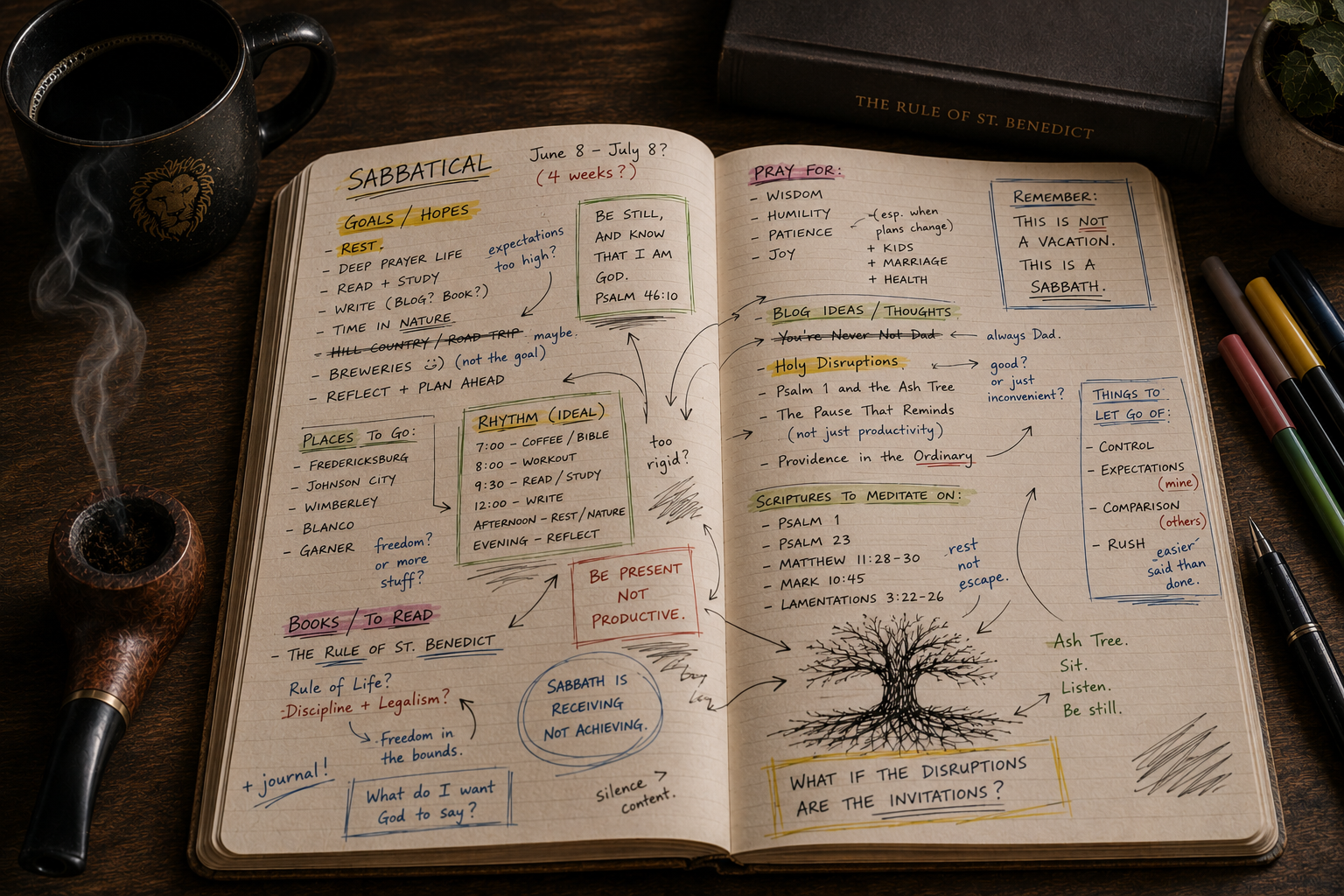
Holy Disruptions

July 28, 2026 by Marco De Leon

My man C.S. Lewis wrote, “the great thing, if one can, is to stop regarding all the unpleasant things as interruptions of one’s ‘own,’ or ‘real’ life. The truth is of course that what one calls the interruptions are precisely one’s real life — the life God is sending one day by day.” I have found Lewis’ words incredibly meaningful over the last several weeks of my sabbatical, which have been filled with what I’ve affectionately come to call, holy disruptions.

If there’s one thing I’ve learned during this time away, it’s this: the Lord uses seasons of rest to expose the soul through the surprise of providence.

ANTICIPATION
By God’s grace, I’ve served in pastoral ministry for the last twelve years. It’s been one of the great joys of my life. During that time, the Lord has carried our church through everything from replanting, the COVID-19 pandemic, and countless other ordinary hardships.

One of the greater challenges has been shepherding our congregation alone. While I realize many churches and traditions wouldn’t necessarily find that strange — a solo shepherd — I am convinced that Christ intends His church to be led by a plurality of elders (Titus 1; 1 Peter 5). Because of that conviction, I delayed taking a sabbatical for years. However, that’s not to say I never received time off, but it was always rhythmic, brief, and with the intention of returning quickly. Long ago, I decided I would only step away for an extended sabbatical once the Lord provided additional elders to help shepherd our church.

Year after year, that prayer remained at the forefront of my mind as leaders were developed, deacons affirmed, and men entered our pastoral residency, sincerely discerning a call to ministry, only to learn the Lord was leading them elsewhere. On one hand, it seems like our residency was accomplishing exactly what it was designed to do — helping men discern whether they were truly called. On the other hand, each departure carried another measure of disappointment.

Then, the Lord, in His providence, answered our prayer earlier this year as our church affirmed our newest elder. It was such a great celebration for our congregation and, if I’m honest, an enormous relief for me! For the first time in a long time, I no longer felt as though I was carrying the weight of pastoral ministry alone.

One of our first conversations was about creating space for me to step away — to rest, recalibrate, and then re-enter ministry healthily. It was such a gift to me from our church and gratefully received. Graciously, I was given 12-weeks and being the architect that I am, I immediately began planning. The sabbatical would unfold in three phases. First, I assembled a small sabbatical care team — men who would speak into my plans, offer wisdom, prayer, and serve as representatives for our church should questions arise.

Second, I would prepare the congregation by explaining the purpose and nature of the sabbatical.

Third came the plan itself: spending most of the summer at home, traveling with Rebecca for a few weeks, a solo retreat, and meeting with a counselor while away. Part of me resonated with a pastor David Murray quotes in ReSet: “My ministry had become a shell without a heart, a matter of endless duties without joy. I was standing up every Sunday telling God’s people true things, good things. But they were no longer things that I lived on personally. It was my job.”

While I couldn’t fully identify with his burnout, I certainly sympathized with much of what he described. The timing couldn’t have seemed more perfect. Everything was on track, planned well, and ready for execution. And then the sabbatical started…and so did everything else.

A HUMBLING REALITY
I began this sabbatical with the intention of simplicity. I wanted to reorganize my office, spend more time with Rebecca, take my solo retreat and hike through the Texas Hill Country, and visit a few new breweries. Then week one arrived. Our water heater failed. Thankfully, we had money set aside for unexpected expenses. A few days later, we discovered electrical issues in the house. The emergency funds were still holding!

Week two brought something entirely different. I was called out of sabbatical due to the moral failing of a pastor-friend within our church planting network. It shook our staff and the rest of our network churches. The following days were filled with grief, prayer, and processing.

Once I stepped away, Rebecca and I thought resting would begin until she ate seafood and suddenly broke out in hives from her ankles to her neck and needed steroid treatment to reduce inflammation, itching, and irritation. Simultaneously, our son got a job in the DFW which was an answer to prayer, but it also meant he needed to move during the week of my solo-retreat.

It seemed like it was one thing after another. We weren’t discouraged exactly. Maybe disheartened. Then, on the second day of my retreat, my son’s truck broke down. Thankfully, being a great mechanic, he was able to bring it to life and join me in the Hill Country for a day in order to ensure his truck was good to go for the remainder of his trip, and most significantly, we got to spend time together before the start of his career. Once he was on the road the following morning and arrived in McKinney, TX safely, I was officially on vacation. Let the hiking begin!

The next day, my truck broke down. Two days later, the truck was repaired and Rebecca joined me in the Hill Country. “This is it,” we thought. We were excited about our time away, not to mention an adventure to Big Bend National Park only for Rebecca to receive a call and learn that her car was taken to the Subaru dealership due to transmission issues.

No worries, however. We had my truck — until it stalled again.

At that point, we made the difficult decision to come home two weeks early to get everything repaired on our vehicles with what we had saved for our trip away. It made sense — get everything fixed so we don’t have to worry about this in the future, but still, there was the discouragement of yet another expense hitting us in the face. And believe it or not, there’s more! But I’m sure you get the point.

Here’s why I share all of this. As meticulously as I had planned this sabbatical, I came to learn two things.

First, I must confess, I saw sabbatical as more of an escape instead of an invitation to rest in Christ. I didn’t want to admit this. Each interruption was a blow to my personal kingdom and plans. I wanted to get away, but not draw near. I was reminded of Travis West’s book, The Sabbath Way, where he writes that the Sabbath “is to invite disruption.” That small line hit harder this season.

Second, the Lord used disruptions to not only humble me, but minister to me. Holy disruptions became the primary vehicle the Great Shepherd shepherded my own heart.

While I was consumed with getting to the “next thing” — the next place, the next hike, the next vacation, the next moment where I would finally rest — I failed to hear Jesus’ invitation, “Come to me all who are weary and burdened and I will give you rest.”

I was chasing a place on sabbatical, but I had forgotten that the sabbath is about a Person.

ORDINARY PROVIDENCE
At first, frustration and discouragement seemed to be the defining themes of this sabbatical. Yet, with every disruption, the Lord gently reminded me that while I was fixated on what wasn’t happening, He was quietly at work in what was. For the sake of brevity, allow me three examples.

First, although Rebecca and I were disappointed that our adventures had to be postponed, we still received an entire week together away. We slept in, drank coffee together, and read and discussed the Word daily in ways that we hadn’t in months. And even with my not-so-reliable truck, it had enough juice to take us into town everyday for a date. The Lord gave me the gift of dating my wife again.

Second (and I’ll write more about this one later), I wasn’t able to be home on my son’s last day in McAllen, but I ended up getting an entire day with him in the Hill Country where after he fixed his truck, I cooked us lunch and then visited a brewery, playing UNO for hours. When morning came, I received a gift that I thought I’d never have again as a dad. I was up with him at 4:30 a.m. fixing him lunch and brewing coffee for the road. It was like packing his lunch for school when he was in elementary all over again. As I watched and blessed him as he drove away, I realized the Lord had given me the gift of one more ordinary morning with Chango.

Third, despite every disruption, I spent time in the Word every day, being with Jesus. Only a few weeks earlier, the exhaustion of ministry had quietly eroded that consistency. Yet, in the middle of water heaters, vehicle repairs, canceled plans, and unexpected expenses, the Lord drew me near. The Lord gave me the gift of Himself.

As I look back, what once felt like a collection of frustrating disruptions now seem remarkably different. They weren’t random inconveniences, but reminders of God’s ordinary providence. While I was preoccupied with my plans, He disrupted them and was inviting me to notice the gifts that He was giving.

In many ways, that’s how providence works — it’s rarely spectacular, usually pretty ordinary, and almost always easier to recognize in hindsight.

FINAL THOUGHTS
We’ve been home for a few weeks and thankfully, both of vehicles (and everything else) has been taken care of. Ironically, we’ve rested more in the last few weeks than we did at the start of all of this. I don’t think it was because the start of this sabbatical lacked moments of joy or tranquility, but because somewhere along the way, the Lord began to change my understanding of rest.

The thing is, sometimes God’s providence is revealed through extraordinary moments, but more often it’s revealed through ordinary disruptions. In either case, He is accomplishing His purposes for His glory and our good.

With all of this being said, here’s what I leave you with —

First, the sabbath is more than rest, it’s about a Person. What if, when Jesus said, that He came not to be served, but to serve (Matthew 20:28), He meant it? What if Sabbath is one of the ways Jesus continues to minister to His people — not because we’ve accomplished so much to deserve it, but because He delights in caring for weary sheep? Rest isn’t just a command, but a gift to receive. St. Benedict wrote, “the first step to humility is obedience without delay.” Do not delay in resting.

Second, in my case, the Lord chose to use disruption as a means of grace. Every broken plan exposed something in my heart, every inconvenience became an invitation to trust Him a little more, and every interruption reminded me that His kingdom was more important that my carefully curated one. Maybe He will use disruptions in your life. Maybe He won’t. He probably will. The question, however, isn’t whether your plans will be interrupted, but whether you’ll be quiet enough to consider His providential care.

Third, David Benner writes, “the single most important thing I have leanred in over thirty years of study of how love produces healing is that love is transformational only when it is received in vulnerability.” I think that’s true. This sabbatical exposed places in my heart that still preferred control over surrender, escape over communion, and carefully crafted plans over daily dependence. Again, Benner writes, “relying on the will to make things happen keeps us focused on the self.” The Lord dismantled those illusions — not to shame me, but shepherd me.

As Father Cavanaugh, in the film Rudy explained, “there is a God and I am not Him.” Neither am I. Looking back, I realize the disruptions weren’t getting in the way of my sabbatical, they were my sabbatical. The Lord wasn’t keeping me from rest, but teaching me where true rest is found.

My man, C.S. Lewis was right — “the great thing, if one can, is to stop regarding all the unpleasant things as interruptions of one’s ‘own,’ or ‘real’ life. The truth is of course that what one calls the interruptions are precisely one’s real life — the life God is sending one day by day.”

Perhaps the Lord is using disruptions today to expose your soul through the surprise of providence. Don’t be too quick to wish them away — they might just be the place where Christ intends to meet you.


July 28, 2026 /Marco De Leon
Sabbatical, Rest
Comment

Why I Built A Study (And You Should Too)

June 27, 2026 by Marco De Leon

C.S. Lewis once said that “the true reader reads every work wholeheartedly, making himself as receptive as he can.” Every Christian should have a study — whether it’s a small study at home, a short shelf in the living room, or a backpack filled with books, it is both good and necessary.

The purpose of a study shouldn’t be for the sole intention of gathering information (although that partly what happens), but to be discipled by saints who have gone before us and those whom the Lord is at work through currently. While there isn’t anything new under the sun, it doesn’t mean there’s nothing new for you to learn today.

For years, I have been curating my library. It’s taken so many different shapes over the last fifteen years. I’ve owned too many books, given books away, sold others, and then crowded my desk and shelves again. Looking back, I don’t see indecisiveness, but sanctification. The Lord has used countless authors to shape how I think about life, ministry, and the quiet rhythms of ordinary faithfulness.

Books, productivity, and strategic learning have not been nerdy investments nor have they only been interests due to “my wiring,” but they have been formative and the Christian life is formational. As a pastor, I’m not just called to the preparation of sermons or theological development, but meaningful discipleship. A pastor’s study is a wonderful step toward personal discipleship. A reminder that pastors are not only students, but sheep too.

There are books that have been challenging, while others have been comforting. But one thing that’s for sure, the Lord has used books to help shape an approach to faithful ministry and the stewardship of presence.

So, build the study — whatever it looks like. Do the reading — not just for information, but formation. Start with where you are and with what you can — that’s the point of being faithful. And over time, watch the Lord shape the posture of your heart as you steward your time, ministry, and ordinary rhythms.

Lewis reminds us that the true reader approaches every book with an open heart. May we do the same, trusting that the Lord often uses faithful authors to form faithful disciples.

June 27, 2026 /Marco De Leon
books, pastoral ministry
Comment

Discipleship Basics

May 24, 2025 by Marco De Leon

UPDATE
To an aspiring writer, it is said that Hemingway wrote, “You shouldn’t write if you can’t write.” That resonates with me. In the last few years, I’ve wanted to write, but didn’t. Now, there seems to be not motivation, but desire.

One of the ways I’m beginning this journey is through articles that I intended on publishing, but didn’t get around to it. Today’s post, in particular, comes from an afternoon spent with my brother in 2019. I hope it’s helpful as you make disciples. Cheers.

INTRO
Last weekend, Chango and I visited my brother, Meme, at his workshop in my parents’ house. My brother loves woodworking and is fascinated by hand crafted Japanese tools and various saws. Chango was building a wooden target out of 2x4’s and needed help reinforcing the boards by adding back support and needed Meme’s help.

What I witnessed was probably one of the most basic and effective ways to communicate discipleship. Here are three observations I made during our time:

1. I DO, YOU WATCH
Before hanging out with Meme, Chango had measured the sections of the board that he needed cut, but didn’t double check his markings or his math. When Meme checked his work, he went back and taught Chango the golden rule of woodworking, “measure twice, cut once.” Meme busted out his tape measure and special pencil and showed Chango the importance of measuring correctly, patiently, and with the right metrics.

Once he corrected Chango’s measurements, he taught him how to hold the saw and cut correctly. Afterward, Meme laid support pieces on top of the target and showed Chango how to drill and screw wooden screws (I don’t know the technical term).

79A9C1AC-5A29-490F-9B7D-447D51C03DEA.jpg

Here’s my point, Meme’s job was to teach the “how” and the “why.” Chango’s job was to observe while asking questions along the way. When Jesus tells His disciples, “teaching them to observe all that I have commanded you” (Matthew 28), the word for “teaching” isn’t so much a classroom-type of learning, re-learning through experience and correction. There is a space in discipleship that involves bringing someone along with you as you share life with them and teach them as you go.

2. I DO, YOU HELP
After drilling and securing the first portion of the target, Meme moved on to the middle piece only this time, he grabbed Chango’s hand to teach him positioning and what to expect. Additionally, he was going to observe Chango along the way.

E65B8E84-6854-4A8E-94F0-54C1276853FC.jpg

When we consider the four gospel accounts, we see Jesus not only teaching the disciples formally, but informally. He includes them in things such as teaching them how to pray or how to speak of the kingdom. In discipleship, there is a space that includes folding others into what you’re already doing in your walk with Jesus, adjusting as you move forward.

3. YOU DO, I WATCH
For the last piece, Meme told Chango, “now you know, so let me see it.” Chango secured and fastened the final piece by himself and Meme was at his side. In Matthew’s gospel, Jesus promises the disciples (and us) that He will be with them always. They were given a responsibility and commission, but were never on their own or never not making disciples. Discipleship is never in the context of isolation, but community.

B7D1CB7D-A21E-4DEB-8AF8-0818F3217EB0.jpg

FINAL THOUGHTS
One final observation about the time with Meme: it wasn’t a formally scheduled session. This was Chango hanging out with his Tio in real time over the course of an afternoon. In many cases, discipleship is reduced to a formal meeting over charred coffee at Starbucks and while that may happen on occasion, discipleship is an invitation through everyday ordinary life to know and live like Jesus.

Discipleship is an absolute necessity in the Christian life. The lie is that you can be a follower of Jesus without being a disciple. Friend, that’s stupid. It’s not found in the pages of Scripture and is a foreign concept to God’s word. Therefore, let us heed the command of Christ to make disciples who know and live like Jesus.

Featured
Classroom..jpeg
May 24, 2025
Discipleship Basics
May 24, 2025
Read more →
May 24, 2025
Espresso.jpeg
March 13, 2019
What Are You Fighting For?
March 13, 2019
Read more →
March 13, 2019
Classroom.jpeg
March 4, 2019
Make Disciples or Mature Disciples?
March 4, 2019
Read more →
March 4, 2019
May 24, 2025 /Marco De Leon
Discipleship, Life
Comment
Churh pew.jpeg

Liturgy: Habits Shaped by Grace

May 16, 2025 by Marco De Leon

For several years now, I’ve been told that our Sunday service is fairly liturgical (others would argue that we’re not liturgical enough!) and I think I know what they mean by this comment. What they’re implying is that the order of our service has some early church elements such as a pastoral prayer, weekly communion, or a benediction. Apparently, Roman Catholic churches where Gregorian chants take place can only have this imbedded into their services, but I digress. A liturgy, in the end, is a discipleship tool and the Sunday gathering is more than a weekly service: it’s where the people of God are gathered to be shaped by habits of grace.

So, let me set the record straight. Allow me to address the elephant in the room. Let’s place on the table the real chicharron: all churches are liturgical. Every single church across various denominations have a liturgy.

WHAT IS LITURGY?
For some reason, the word “liturgy” has fueled interesting buzz around many theological camps. It seems as though, 20 years ago the wave of church planting was sexy and stimulating whereas today, the new rave is about liturgy because it promotes familiarity and stability. I have some thoughts about why this is taking place, but that’s for another post.

Concerning the word “liturgy.” It comes from the Greek word, leitourgia, which is a combination of two words: people and work. A liturgy is a “work of the people” and most simply refers to the order of service. Therefore, if your church begins Sunday with only one song, prayer, a sermon, and then a dismissal that is a liturgy. If your church has a call to worship, pastoral prayer, assurance of pardon, sermon, songs, and a benediction then you have a liturgy. If your church has any order of service (ANY order of service), then you have a liturgy.

What I’d like to stress, however, is that in spite of what your liturgical order is, is it intentionally spiritually formative for your congregation?

HABITS OF GRACE
The biggest reason that we have placed so much intention behind our liturgy is because it’s more than an order of service, but habits shaped by grace for weary sinners. Every single element in our liturgy is meant to communicate something about the character of God and when the saints gather weekly, my desire is for them to be spiritually formed by grace-filled order in their lives.

There’s much to consider when people get to church on Sunday. For some, their work week has gone well and their days may have been coated with some rest and enjoyment. Then, there are others who are exhausted and running on fumes from their week. Some may have been encountering one of the most challenging seasons of their life and are battling everything from sin, depression, and spiritual apathy. So when these individuals come to our church, I want to ensure that we’ve done everything possible for them to expericence God’s grace for them the minute they walk through the door.

We place a high value on a culture of hospitality. The first experience someone is going to have when they walk through the door (member or visitor) is one of gospel centered hospitality. Our lobby is warm, inviting, and designed for one to be able to stop and breath, even if it’s for a moment, so their your mind and heart prepare for the rest of the service.

Once in service, each element is an ongoing habit that helps to shape the heart by grace. For instance, the call to worship is designed to grab our intetion of the beauty of God, our pastoral prayer is meant to comfort hearts as we cry out to God, the song selection is not meant to only invoke emotion but the worship of God, the sermon proclaims the goodness of God for sinners and sufferers, communion is a spiritually tangible reminder of God’s grace for weary sinners, and the benediction is both a blessing of dismissal and deployment.

An intentional liturgy should be a thoughtful construction of habits that shape weary sinners by God’s grace in order to continue walking and working faithfully with the Lord throughout the rest of their week.

FINAL THOUGHTS
Every church has a liturgy. The question is whether or not there’s more to it than a simple order of service. For the weary saint, it has to be. For the encouraged saint, it has to be. For the suffering saint, it must be. For the one who doesn’t know Jesus, it needs to be.

Everything else in their life is shaped by something, a habit. Our lives are literally daily liturgies. Therefore, let us seek to create intentional litugries in our churches so that the people are best shaped by habits of grace.

Featured
Holy Disruptions.png
July 28, 2026
Holy Disruptions
July 28, 2026
Read more →
July 28, 2026
Bookshelves.jpg
June 27, 2026
Why I Built A Study (And You Should Too)
June 27, 2026
Read more →
June 27, 2026
Classroom..jpeg
May 24, 2025
Discipleship Basics
May 24, 2025
Read more →
May 24, 2025
May 16, 2025 /Marco De Leon
Sunday, Liturgy
Comment

Pseudo-Productivity

August 02, 2024 by Marco De Leon

When I worked for the City of McAllen, there was an unspoken rule that claimed our office: we could not leave our desk earlier than 5:00 p.m. On most days, my co-worker would stop by my office around 4:15 p.m. to chat about upcoming projects and current programs that we ran within Parks and Recreation. On occasion, our director would drop by and ask, “what are you boys talking about?” We’d share an ambiguous idea with our intention being to speak long enough until the clock struck 5:00 p.m.

Oddly, for my co-worker and I, even though 5:00 p.m. was the official “quitting” time we still had responsibilities at our facilities in the evening! If we didn’t, during the slow seasons such as the winter breaks, we normally accomplished our work shortly after lunch. But 5:00…

I digress.

These conversations were simply water-cooler chats, exchanges meant to pass the time and give the appearance of productivity. We both knew what we were doing. We “worked” for the sake of activity, not productivity.

PASTORAL MINISTRY
Now, after ten years of pastoral ministry, and up until recently, I’ve learned that I carried some of this ethic into my current responsibilities. Earlier this summer, I read Cal Newport’s book, Slow Productivity, and his opening chapters begin with the tale of what he calls pseudo-productivity which he defines as “using visible activity as a crude proxy for actual productivity.”

I’ve learned that on one hand, there’s a self-imposed pressure that I place on myself to be working all day because of personal guilt. I think to myself that if those in my congregation who work 9-5 jobs or work in trades can’t have afternoons free then neither can I. My guilt tells me that even though my evenings are booked by counseling sessions or discipleship opportunities, I need to work just as long, if not longer, than everyone else.

Then, on the other hand, I have this preconceived notion where I think my congregation is thinking that I should be working around the clock — not simply for the sake of availability, but hustling unhealthily. And yet, as I’ve shared these thoughts with members in my congregation, none of them feel that way. They care about whether or not I’m healthy so that I can continue to preach/teach, pastor, and develop leaders in the church.

The result of these two self-imposed pressures the experience of spiritual and mental exhaustion — not quite burnout, but the symptoms are similar: frustration, cynicism and apathy.

THIS ISN’T UNIQUE
I’m not the only pastor or ministry leader who experiences this. I’ve met with several pastors who shared similar experiences and similar pressures, but do not know who to share it with for fear of being misunderstood and having poor ethic.

The truth is, ministry is simply different and when we fold previous ethics and expectations (apart from personal ones) into our current ministry then the possibility of spiritual exhaustion increases. In short, ministry requires us to work differently and because of this, there is much more freedom than we think. The challenge is embracing some of that freedom.

FAITHFULLY PRESENT & PRODUCTIVE
It’s not uncommon to wear multiple hats in a ministry context. Therefore, our approach towards work may look different from many. However, that does not mean nor does it imply that pastors and ministry leaders work less diligently — far from it. We must understand that ministry is a work of faithful presence and productivity.

In his book, Newport provides three principles for what he calls Slow Productivity. Here, I’ve adapted them in a way that may be more suitable for those in ministry to consider:

  1. Think Deeply
    One of the great gifts of pastoral ministry is thinking deeply on the word of God; reading sound theology for a deeper understanding of the Scriptures and your own formation; communion with God; and prayer over your church. This methodical work benefits your personal spiritual formation and that of your congregation. Whether it’s an entire day or time blocking your schedule, think deeply on the things of God.

  2. Work at a Natural Pace
    If you’re a solo pastor or are a part of a small staff team at your church, you cannot get to everyone all of the time. In fact, to do so would be irresponsible because that could imply that you’re not protecting precious time that you could be spending with your family, friends, or at work in something else that gives you life (that’s right, I said it). While this entry isn’t so much about guarding your time, you should still consider to work at a more natural pace when it comes to meeting with leaders, staff, and members in your congregation. This does not mean there will not be moments or seasons of intensity, emergencies, and tragedy. This does not undervalue the significance and weight of pastoral care either, but we need our shepherds to be healthy and whole as they carry the burden and blessing of this call in our local churches.

  3. Obsess Over Quality
    Learn your strengths and make them stronger. You and your congregation will benefit greatly from this. It’s not that weaknesses or areas of improvement are unimportant. It’s that you are not gifted at everything and that’s okay. While this could be for another post, a side note would be to recruit and develop other leaders to help where you are weak (Ephesians 4:11-13). For now, where you are strong, grow stronger. When I replanted our church, I knew that I was gifted in teaching, but wanted learn more and grow to be a good and faithful preacher. Since then, there hasn’t been a season of ministry where I wasn’t in a preaching cohort, had a pastoral coach, read books and asked questions, or went to preaching workshops to learn from other godly and gifted men. I thank my church for allowing me these opportunities and not only have I grown as a preacher, but my church has been blessed from it.

What kind of pressures do you place on yourself that keep you from being faithfully present and productive? What kind of unnecessary burden do you carry that is keeping you from growing as a healthy and whole disciple of Jesus?

RECOMMENDED READING
1. The Solo Pastor: Understanding and Overcoming the Challenges of Leading a Church Alone by Gary L. McInTosh

2. Slow Productivity by Cal Newport

3. The Shepherd Leader: Achieving Effective Shepherding in Your Church by Timothy Witmer

Featured
Holy Disruptions.png
July 28, 2026
July 28, 2026
Holy Disruptions
July 28, 2026
July 28, 2026
Read more →
July 28, 2026
July 28, 2026
Bookshelves.jpg
June 27, 2026
June 27, 2026
Why I Built A Study (And You Should Too)
June 27, 2026
June 27, 2026
Read more →
June 27, 2026
June 27, 2026
Classroom..jpeg
May 24, 2025
May 24, 2025
Discipleship Basics
May 24, 2025
May 24, 2025
Read more →
May 24, 2025
May 24, 2025
August 02, 2024 /Marco De Leon
productivity, pastoral ministry, Leadership
Comment
  • Newer
  • Older

Powered by Cigars